← Return to the ArchiveAmara the ArchivistEpisode VIII

Volume VI · An Afrofuturist Mystery

Mansa Musa's
Legacy

"Gold may build kingdoms, but knowledge builds civilizations."

The True Story Behind Mansa Musa's Legacy

Mansa Musa's Legacy

More than seven hundred years ago, the Mali Empire became one of the largest and wealthiest kingdoms in the world. At its height, it stretched across West Africa, controlling important trade routes that carried gold, salt, ivory, and ideas between Africa, North Africa, the Middle East, and beyond.

Its most famous ruler was Mansa Musa, remembered as one of the wealthiest people in history. His legendary pilgrimage to Mecca in 1324 amazed the world with its generosity, diplomacy, and displays of prosperity. Yet his greatest achievement was not the gold he carried—it was the knowledge he brought home.

Mansa Musa transformed cities such as Timbuktu into thriving centers of learning. He supported scholars, built mosques, libraries, and schools, and encouraged the collection of books from across Africa and the Islamic world. Under his leadership, the University of Sankoré became one of the world's leading centers of scholarship, where students studied astronomy, mathematics, medicine, law, philosophy, literature, and geography.

His greatest treasure was not gold.

It was knowledge.

Today, the manuscripts of Timbuktu continue to remind the world that medieval Africa was home to remarkable scholars, scientists, and educators whose achievements continue to inspire us.

This episode of Amara the Archivist is inspired by the true history of Mansa Musa and the Mali Empire. While Amara's adventure is fictional, the people, places, and many of the achievements you will encounter are based on one of history's most extraordinary civilizations.
A kingdom may be remembered for its riches, but it is knowledge that gives a civilization its lasting legacy.

Opening Cinematic

The Golden Sand

The Golden Sand

Opening

The Golden Sand

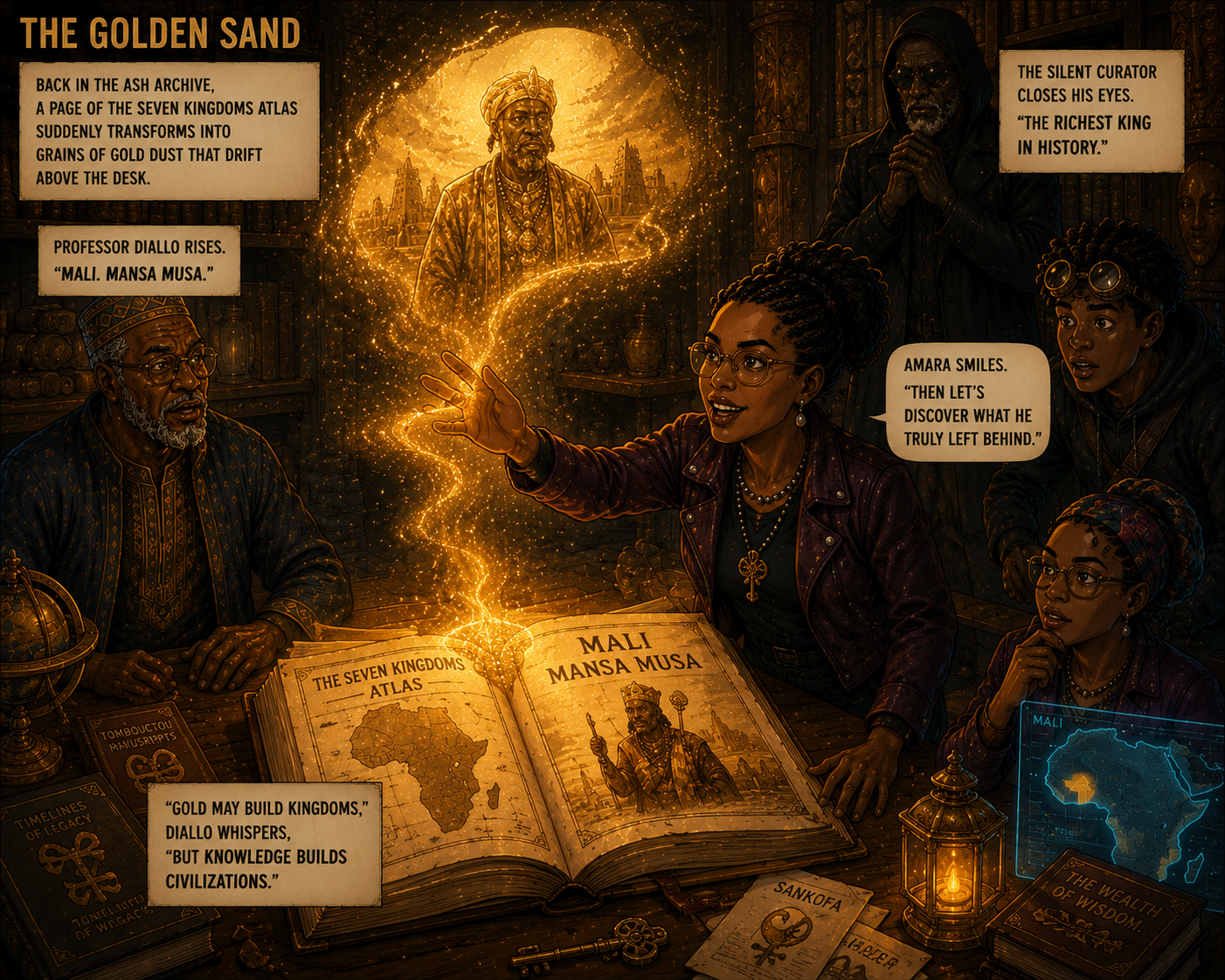
Back in the Ash Archive, a page of the Seven Kingdoms Atlas suddenly transforms into grains of gold dust that drift above the desk.

Professor Diallo rises. "Mali. Mansa Musa." The Silent Curator closes his eyes. "The richest king in history."

Amara smiles. "Then let's discover what he truly left behind."

"Gold may build kingdoms," Diallo whispers, "but knowledge builds civilizations."

Above the rooftops of the city, a Saharan wind begins to blow.

Chapter II

The Caravan of Kings

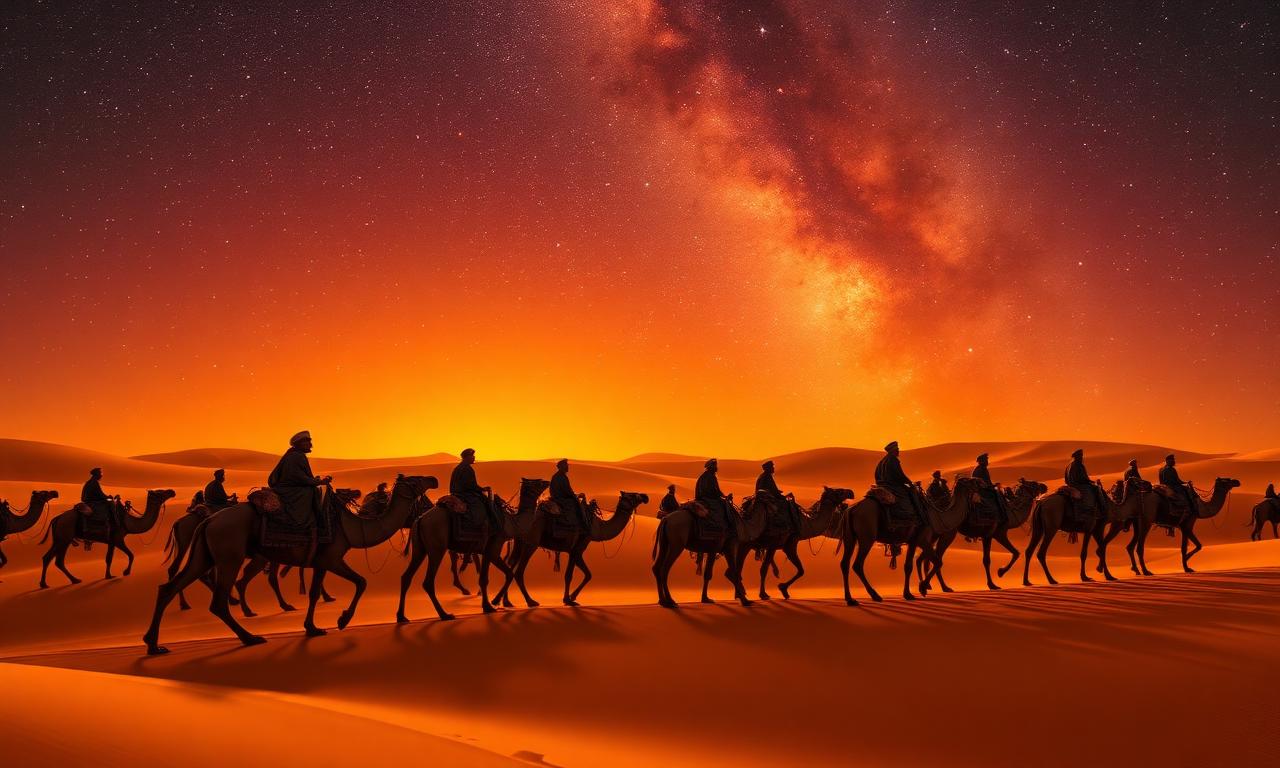
Thousands of camels. Scholars, merchants, pilgrims — and books.

The Caravan of Kings

Chapter II

The Caravan of Kings

The team travels to Mali. Under the stars, Amara witnesses a vision: thousands of camels, scholars, merchants and pilgrims — the great caravan of Mansa Musa crossing the Sahara.

Among the gold and treasures she sees something unexpected. Books. Hundreds of books.

Professor Diallo smiles. "He valued knowledge more than gold."

Nuru sketches the constellations above the dunes. They match a map none of them have ever seen.

Interactive Map

The Empire of Mali

From Niani to Timbuktu, Djenné, Gao — and the long road to Mecca.

Glowing map of Mali and the Saharan caravan routes

Capital of the Mali Empire

Niani

Royal capital from which Mansa Musa ruled the Mali Empire.

  • Mansa Musa came to the throne around 1312 CE.
  • From Niani he governed an empire stretching from the Atlantic to the Niger Bend.

0 / 5 sites explored

Chapter III

The Golden Stool

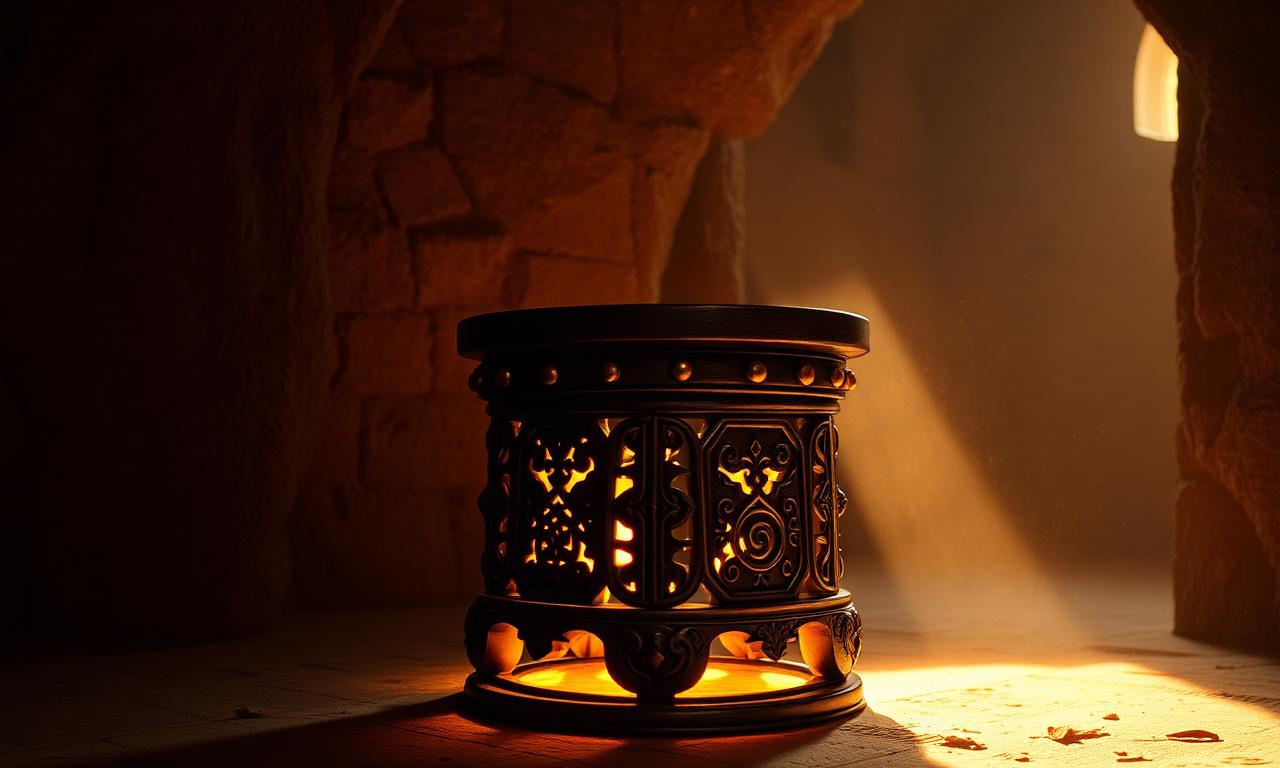
Carved scholar's stool with glowing geometric symbols

Chapter III · The Golden Stool

The Scholar's Seat

Not a throne — a scholar's stool. Nuru studies the patterns. "These are directions." Rotate the stool until the carvings catch the torchlight, then touch it to send the symbols to Kofi's holographic map.

"Authority is borrowed. Knowledge belongs to the one who carries it." — Prof. Diallo

Chapter IV

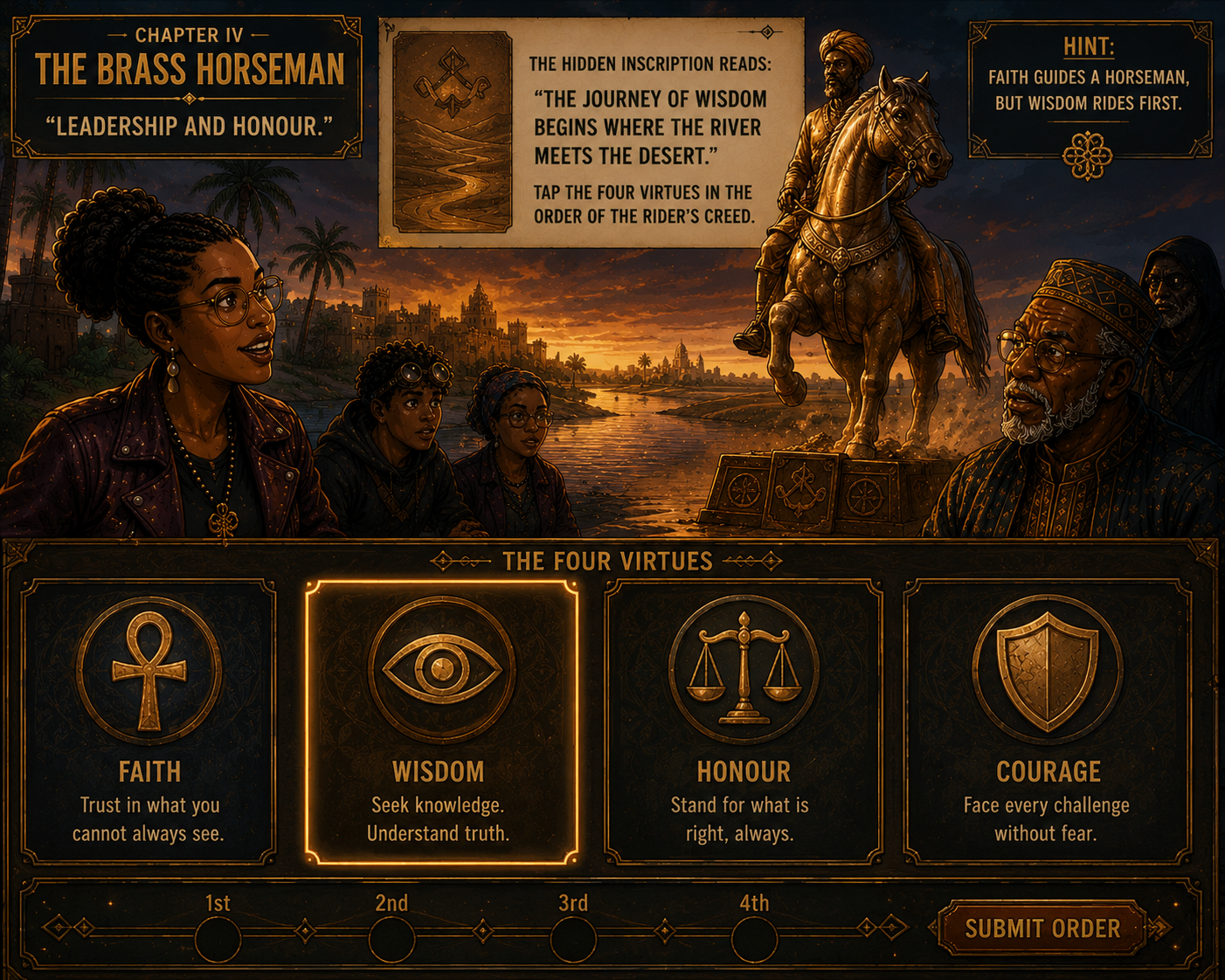
The Brass Horseman

Brass equestrian horseman pointing his spear toward Timbuktu

Chapter IV · The Brass Horseman

"Leadership and honour."

The hidden inscription reads: "The journey of wisdom begins where the river meets the desert." Tap the four virtues in the order of the rider's creed.

Hint: faith guides a horseman, but wisdom rides first.

0 / 4

Chapter V

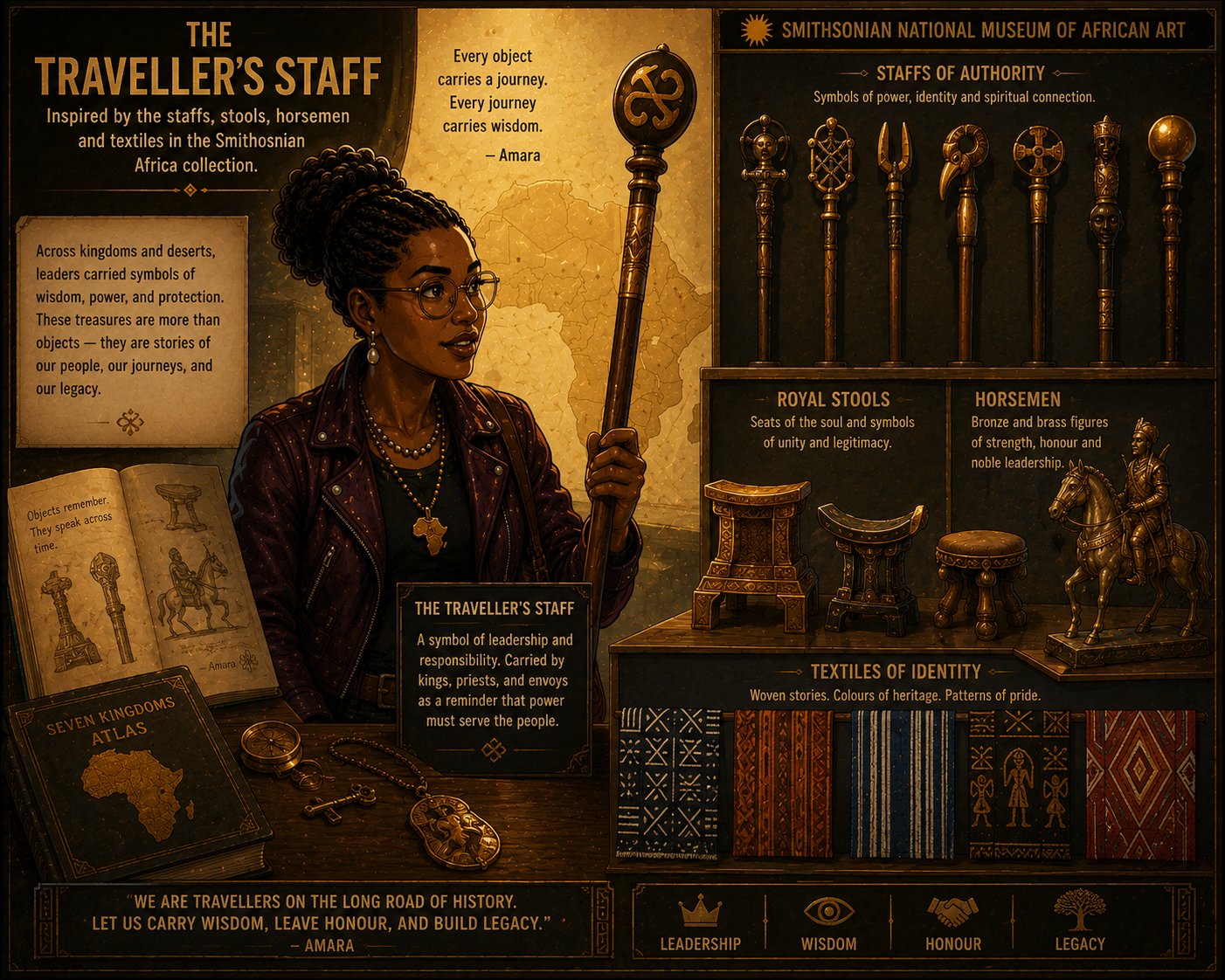
The Traveller's Staff

Inspired by the staffs, stools, horsemen and textiles in the Smithsonian Africa collection.

A Fulani elder presenting Amara with a scholar's staff

The Traveller's Treasures

"He left clues everywhere." — Kofi

Six treasures, six clues. Pick one and Professor Diallo will tell its story.

Inventory: 0 / 6

Chapter VI

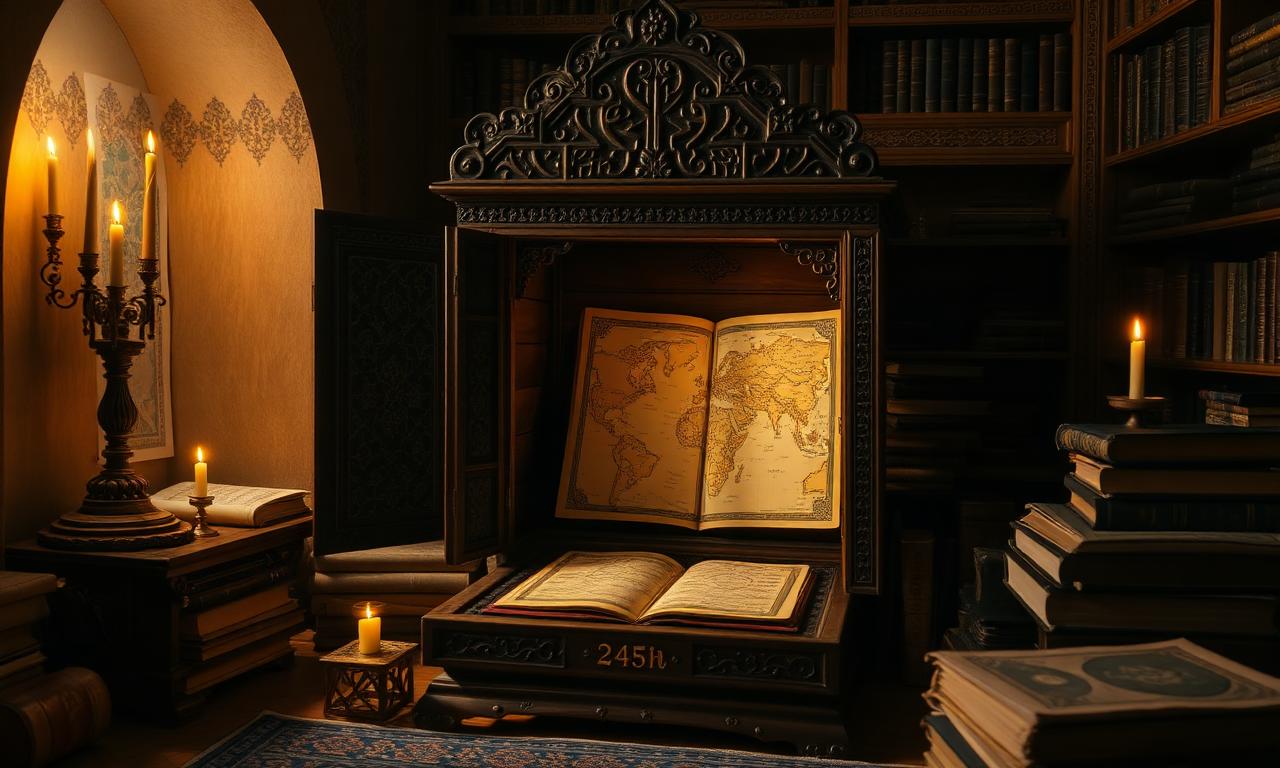
The Koran Stand

Carved wooden Koran stand revealing a hidden map

Chapter VI · The Koran Stand

"Knowledge itself is sacred."

Professor Diallo bows respectfully. Deep inside a family library, an elaborately carved wooden stand holds an old manuscript. Beneath its base, a secret compartment waits.

Lift the stand carefully — the map of Mansa Musa's hidden route lies beneath.

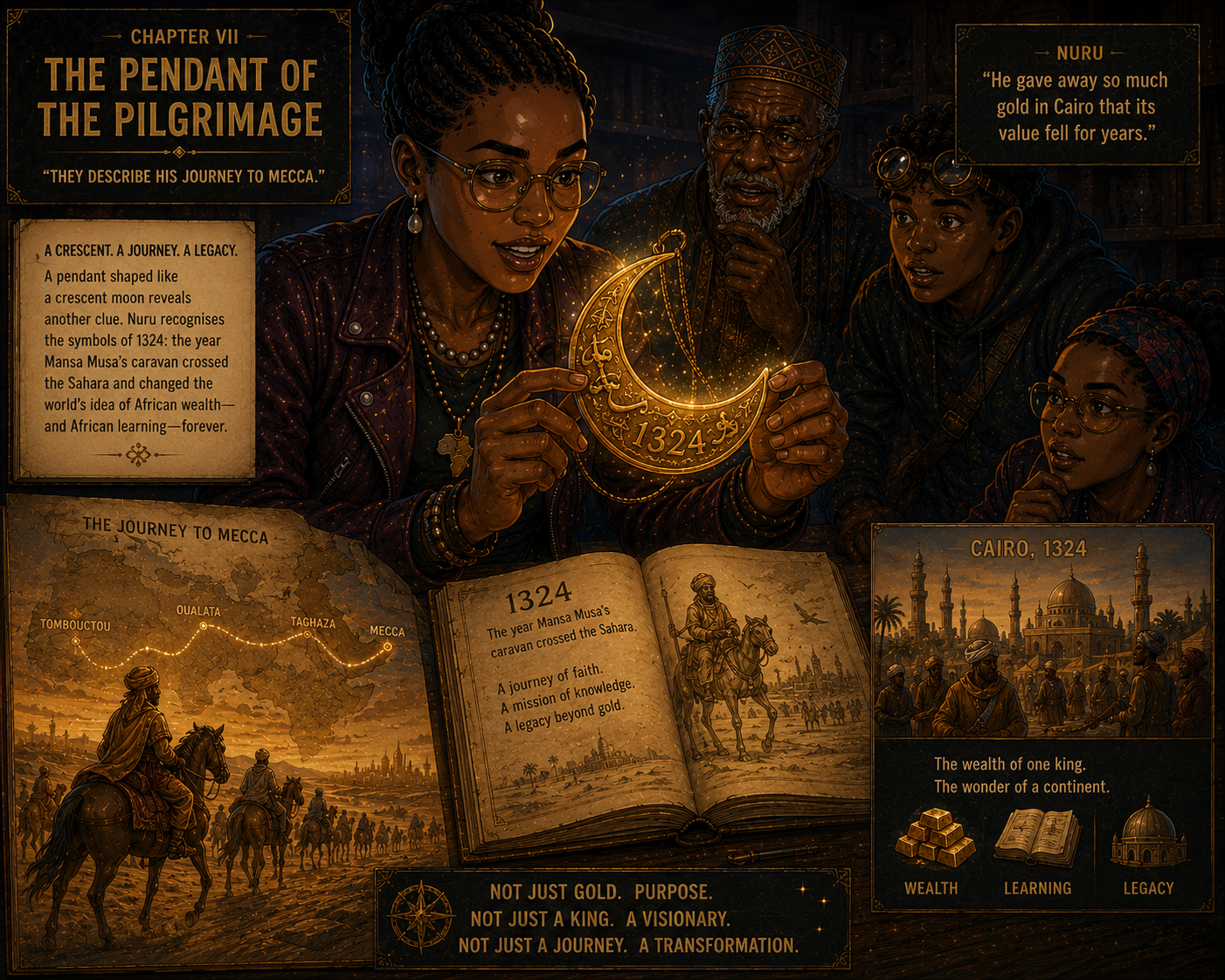
Chapter VII

The Pendant of the Pilgrimage

Gold crescent pendant resting on mud-cloth textile

Chapter VII · The Pendant of the Pilgrimage

"They describe his journey to Mecca."

A pendant shaped like a crescent moon reveals another clue. Nuru recognises the symbols of 1324: the year Mansa Musa's caravan crossed the Sahara and changed the world's idea of African wealth — and African learning — forever.

"He gave away so much gold in Cairo that its value fell for years." — Nuru

Chapter VIII

The Textile of Kings

Chapter VIII · The Textile of Kings

"Patterns are language."

Nuru discovers that the geometric mud-cloth designs correspond to stars. The textile itself is a map. Trace the six stars in the order the weave directs.

Hint: begin in the west, leap to the high north, and end deep in the south.

0 / 6

Chapter X

The Silent Curator's Memory

The Silent Curator's Memory

Chapter X

The Silent Curator's Memory

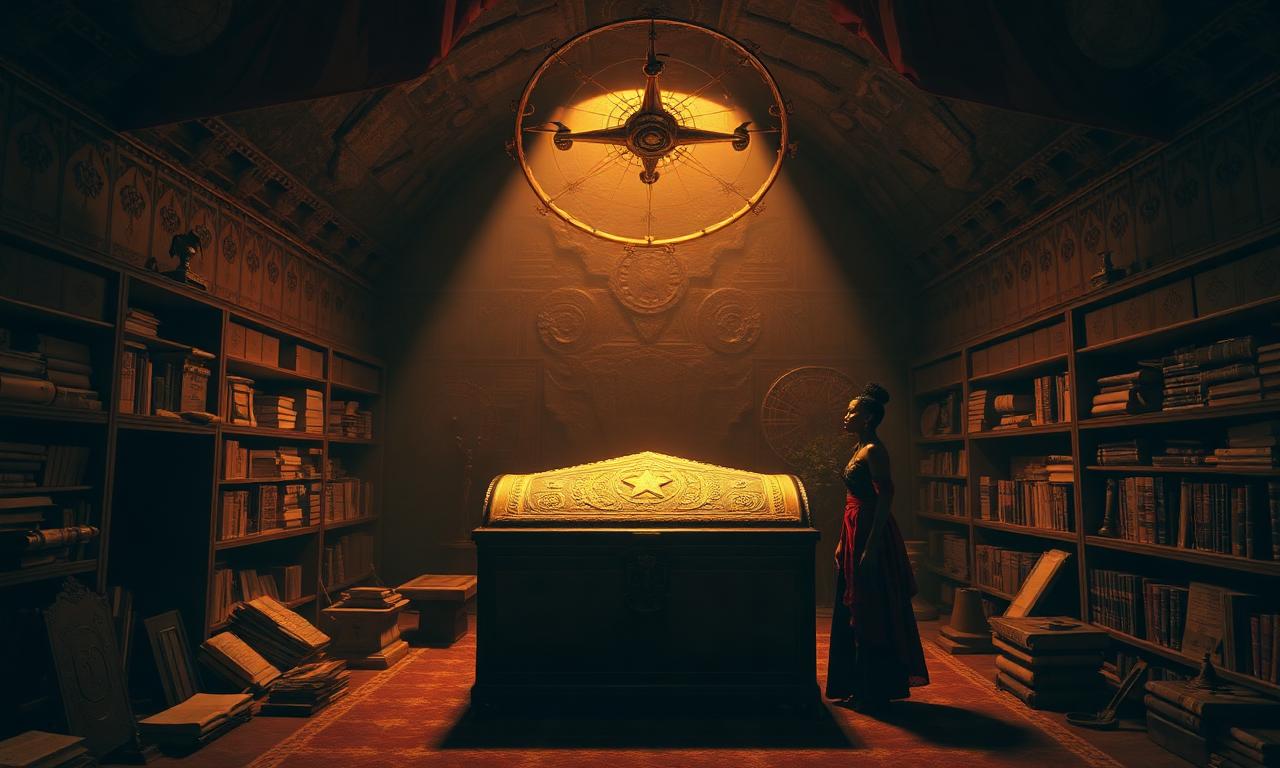
The Silent Curator stands motionless before the bronze chest. "My master brought me here."

Professor Diallo turns. "You have been here before." The old archivist nods. "But I failed him."

He reveals that he once searched for Mansa Musa's secret library — but fear drove him away.

Amara softly answers: "Then walk through the door this time."

For the first time, the Silent Curator steps forward into the light of the chest.

Chapter XII

The Crimson Scribe Strikes

For the first time, the Silent Curator fights at Amara's side.

Crimson Scribe's shadow drones attack Mansa Musa's library

Tap symbols to seal Mansa Musa's library.

Saved 0/8
Lost 0/5

Chapter XII · The Crimson Scribe Strikes

"People worship gold. They do not deserve truth."

For the first time, the Silent Curator stands beside Amara. Together they defend the manuscripts. Each symbol you tap binds another treatise back into the archive.

Seal 8 symbols before five slip through.

Chapter XI

The Treasure of Mansa Musa

The Treasure of Mansa Musa

Chapter XI

The Treasure of Mansa Musa

Inside the bronze chest, Amara expects gold. Instead she finds: letters, architectural plans, treatises on astronomy, records of trade routes, mathematics, medical texts.

And one unfinished manuscript written by Ahmad Baba of Timbuktu.

Professor Diallo begins to cry. "This was his legacy. Not wealth. Wisdom."

From the bottom of the chest, a small brass pendant in the shape of a bird begins to glow.

From the Griot Journal

Mansa Musa (c. 1280–1337)

Ninth mansa of the Mali Empire. Often cited as the richest individual in recorded history.

The Hajj of 1324

His pilgrimage to Mecca, with a caravan of tens of thousands, made Mali famous across the Islamic world.

Timbuktu's Rise

Musa brought back the architect Abu Ishaq al-Sahili, who helped redesign mosques and madrasas in Timbuktu.

Ahmad Baba of Timbuktu

A later Timbuktu scholar whose treatises on law and theology survived in private libraries to this day.

Trans-Saharan Trade

Gold, salt, books and ideas flowed across the Sahara along routes Mali helped to secure.

Mud-Cloth (Bogolanfini)

Hand-dyed Malian textiles whose geometric patterns encode proverbs, stories and identity.

Equestrian Tradition

Cavalry was the backbone of Sahelian empires; brass and terracotta horsemen celebrate that legacy.

Knowledge as Wealth

The real treasure Mansa Musa left was not gold, but a network of libraries, schools and ideas.

Rewards

Badges & Artifact Inventory

Scholar of Mali

Awakened the carved stool.

Locked

Rider of Honour

Solved the horseman's creed.

Locked

Weaver of Stars

Read the mud-cloth as a map.

Locked

Pilgrim of Wisdom

Collected every treasure.

Locked

Artifacts collected: 0 / 6 · Manuscripts sealed: 0 / 8

Chapter XIII

The Final Gift

The Final Gift

Ending

The Final Gift

As Amara touches the brass bird, another page of the Seven Kingdoms Atlas appears.

Professor Diallo gasps. "The Bird of Zimbabwe." Nuru translates the message: "When the builders call, follow the stone birds."

Amara smiles. "Our next journey begins."

Far in the shadows, the Crimson Scribe sharpens his quill once more.

Coming Next · Episode IX

The Bronze Secret of Benin

"The kingdom's greatest mystery is not in the throne room — it is buried beneath the walls of bronze."