← Return to the ArchiveAmara the ArchivistEpisode X

The Soul of

The Golden Stool

Ancient drums beat in the Ash Archive. A throne of pure gold floats above the page. Amara and her companions follow the spirit of the Ashanti Kingdom — from the lightning of Osei Tutu to the rifle of Yaa Asantewaa.

"If you men of Ashanti will not go forward, then we women will." — Yaa Asantewaa
Continue Investigation
The Golden Stool rises in golden dust above the Ash Archive's open atlas

The True Story Behind The Secret of the Golden Stool

The Secret of the Golden Stool

More than three hundred years ago, in the forests of present-day Ghana, the powerful Ashanti Kingdom rose to become one of West Africa's greatest civilizations. Renowned for its skilled leaders, vibrant culture, military strength, and thriving trade, the Ashanti built a kingdom united by a sacred symbol unlike any other.

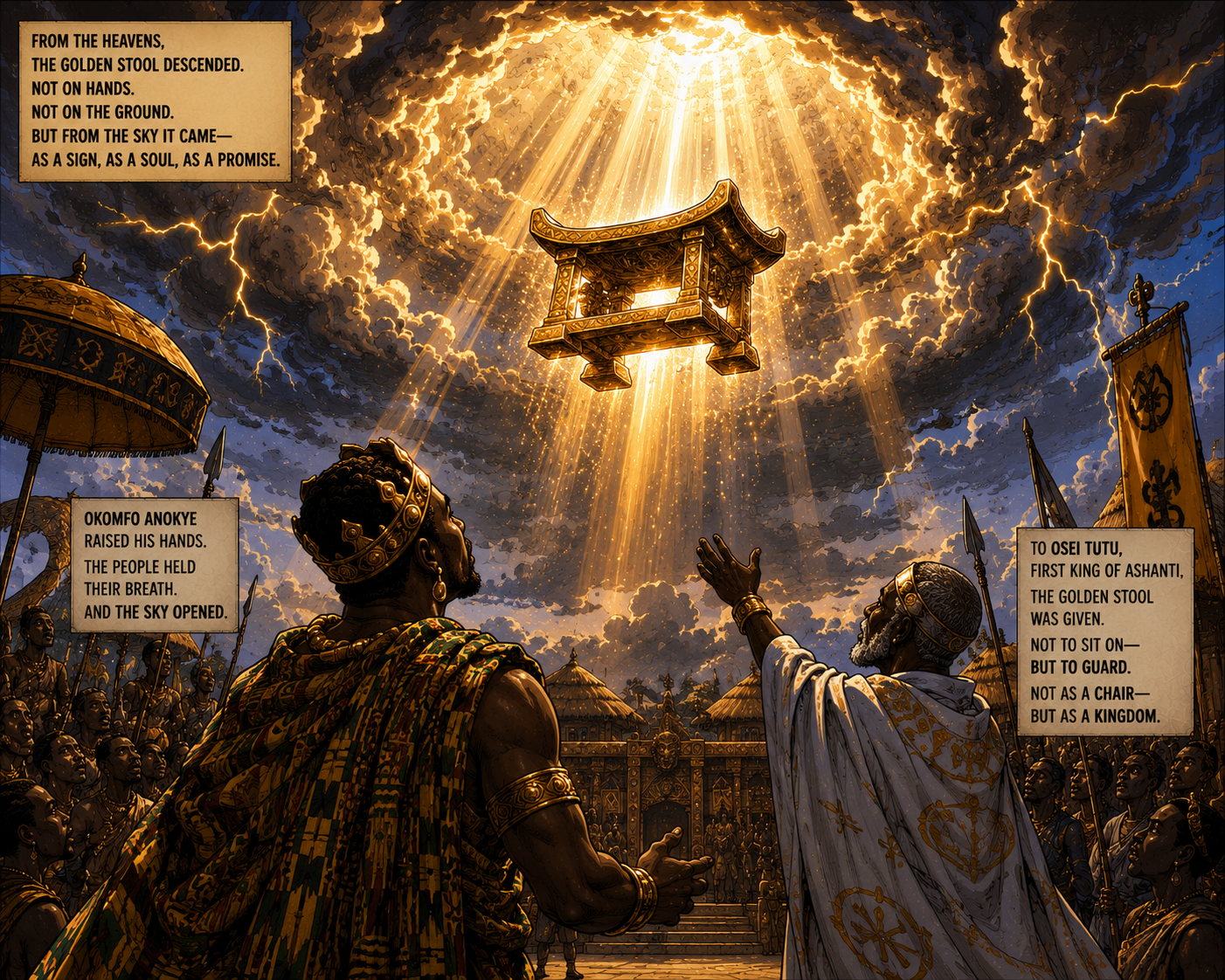
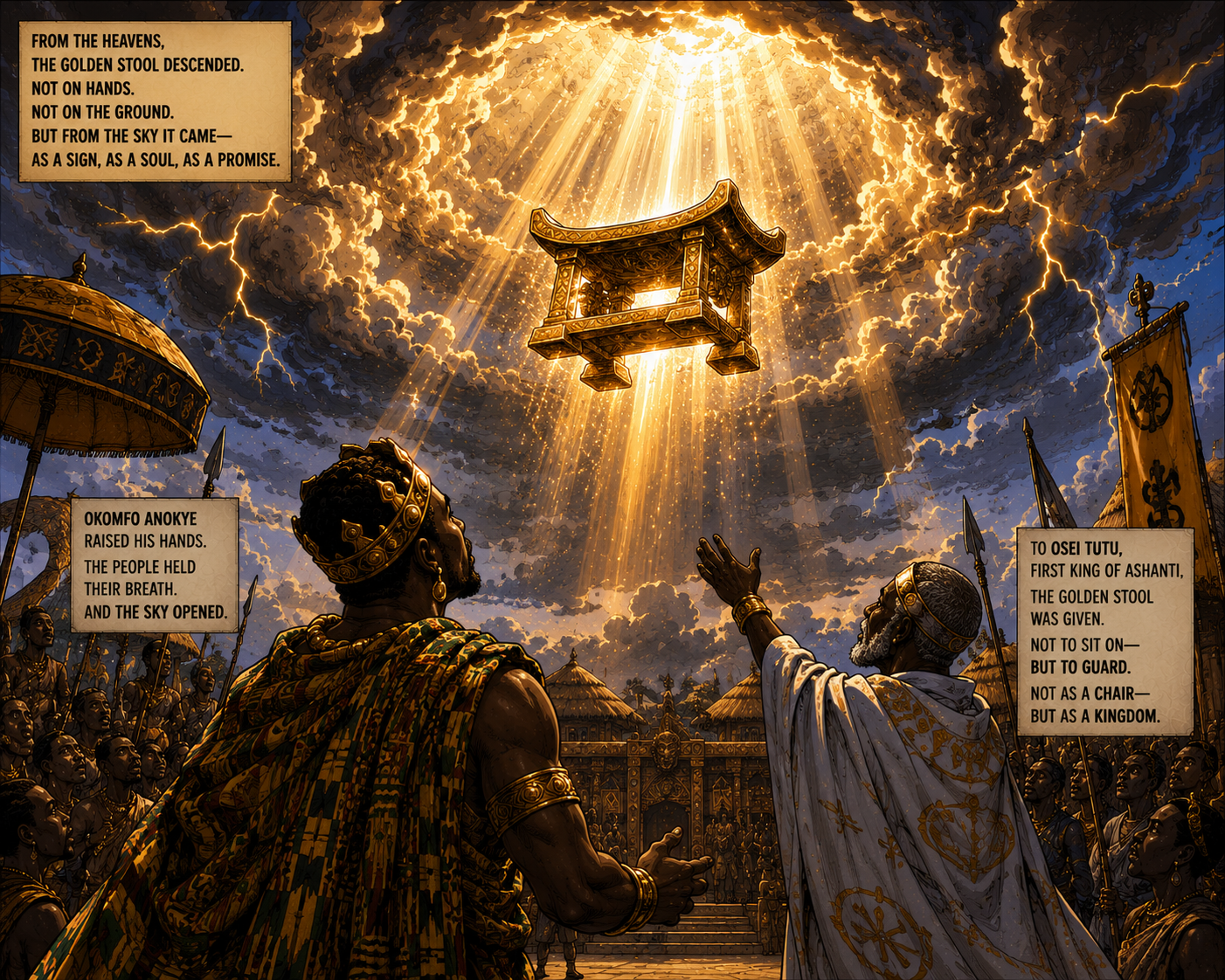
According to Ashanti tradition, the Golden Stool was not made by human hands. It is said to have descended from the heavens through the prayers of the priest Okomfo Anokye, landing gently before the first Asante king, Otumfuo Osei Tutu I. The Stool was believed to contain the spirit, unity, and destiny of the Ashanti nation itself.

Because it represented the soul of an entire people, no king ever sat upon it. Instead, it was honored, protected, and carried with the greatest reverence. The Golden Stool reminded every generation that true leadership is founded on service, unity, wisdom, and responsibility.

In 1900, the Stool became the center of one of Africa's greatest stories of courage. When British colonial authorities demanded that it be surrendered, Queen Yaa Asantewaa rallied the Ashanti people to defend their sacred heritage. Her bravery inspired a nation and made her one of Africa's most celebrated heroines.

Today, the Golden Stool remains one of Ghana's most treasured cultural symbols, reminding the world that a people's identity, traditions, and unity are treasures beyond price.

This episode of Amara the Archivist is inspired by the true history of the Ashanti Kingdom, the Golden Stool, and the courageous leadership of Yaa Asantewaa. While Amara's adventure is fictional, the people, traditions, and historical events that inspired this story are real.

Some treasures are made of gold. Others are made of the spirit of a people.

Scene I

The Drums of the Archive

Ash Archive opens itself as the Golden Stool appears

Scene I

The Drums of the Archive

Inside the Ash Archive, ancient drums begin beating without a hand to strike them. The Seven Kingdoms Atlas opens by itself, pages turning in a wind no one can feel.

Golden dust rises from the parchment. Slowly, suspended above the page, a Golden Stool appears — turning gently, glowing from within.

Professor Diallo whispers, "The Golden Stool." Nuru breathes, "The soul of the Ashanti Kingdom."

Kofi's holographic map activates. A pin of light settles over Ghana. The investigation begins.

Scene II

The Stool from Heaven

The story of Osei Tutu and Okomfo Anokye, told in lightning and gold.

Osei Tutu and Okomfo Anokye as the Golden Stool descends from heaven

Scene II

Osei Tutu and Okomfo Anokye

Professor Diallo tells the story. The sky in the atlas splits with lightning. Storm clouds gather above the painted hills of Kumasi.

The priest Okomfo Anokye raises his hands. The king Osei Tutu lifts his face to the heavens. And from the lightning, the Golden Stool descends — settling on shafts of golden light above the king.

"From that day forward," the narrator says, "the Golden Stool became the spirit of the Ashanti people."

It was never to touch the ground. It was never to be sat upon. It was the soul itself.

Learn More

Tap a card to open its history.

Scene III

The Golden Stool, up close

Rotate. Zoom. Listen to what the carvings remember.

3D rendering of the Golden Stool of the Ashanti Kingdom

Scene III · Interactive Artifact Viewer

The Sika Dwa Kofi

Rotate and zoom the Golden Stool. Each carved face hides a piece of Ashanti history.

The Stool holds the sunsum — the soul — of the Ashanti nation.

Scene IV

The Queen Mother Rises

Yaa Asantewaa raises a rifle as British soldiers approach Kumasi

Scene IV

The Vision of Yaa Asantewaa

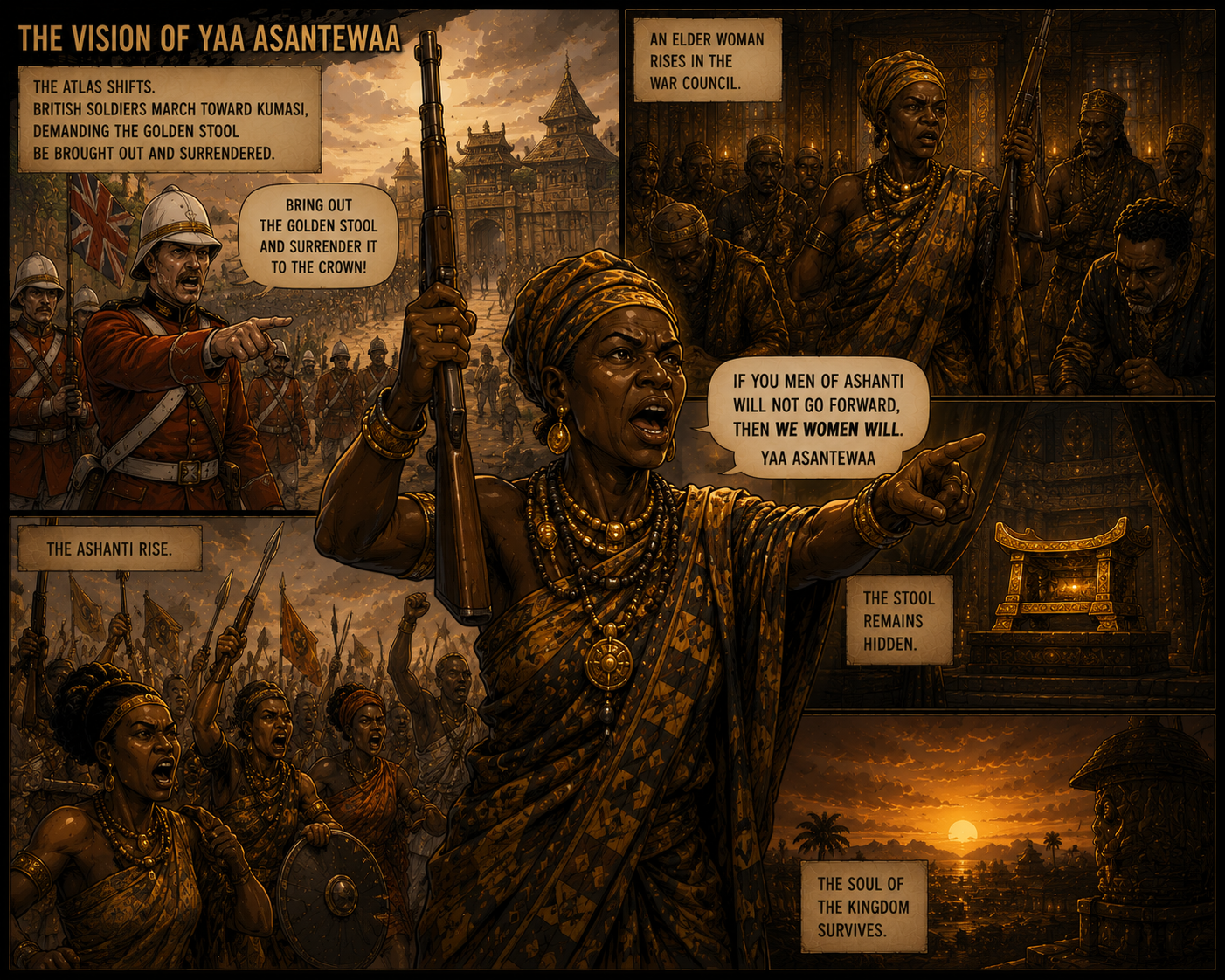
The atlas shifts. British soldiers march toward Kumasi, demanding the Golden Stool be brought out and surrendered.

An elder woman rises in the war council. She lifts a rifle. She turns to the silent men.

"If you men of Ashanti will not go forward," Yaa Asantewaa declares, "then we women will."

The Ashanti rise. The Stool remains hidden. The soul of the kingdom survives.

Scene V

The Adinkra Puzzle

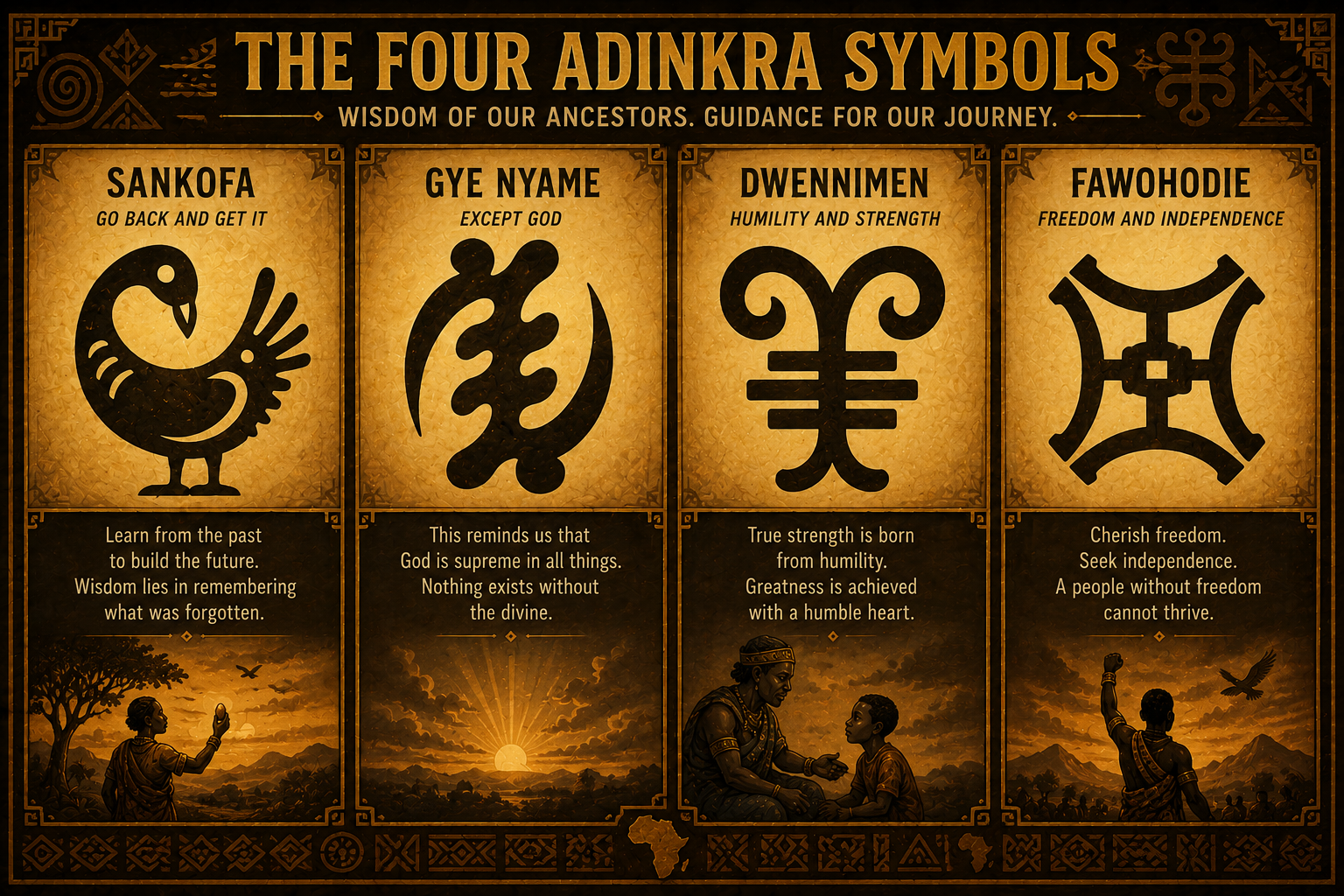
Arrange the four symbols in the order the elders taught.

Four glowing adinkra symbols on a stone altar

Scene V · Adinkra Puzzle

Arrange the four symbols

Hint: "Wisdom before strength. Strength before freedom."

0 / 4

Scene VI

The Hidden Chamber

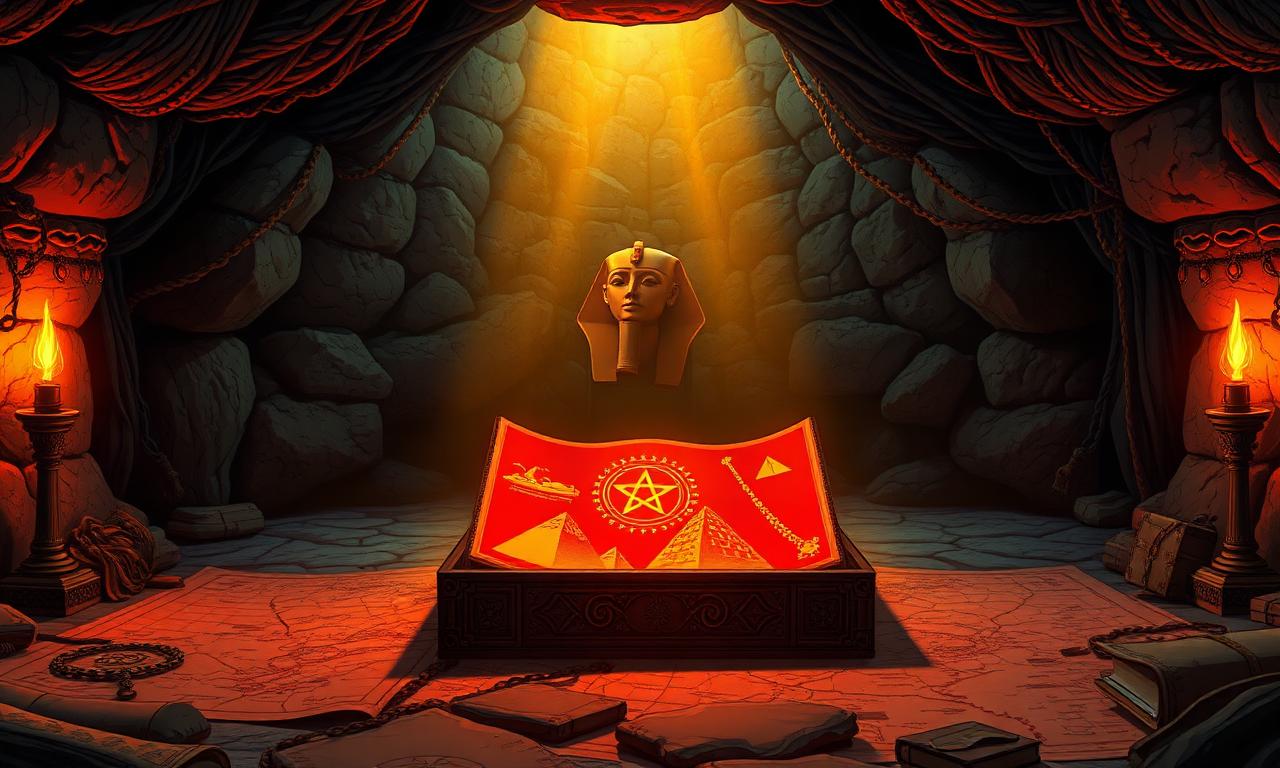
Ebony box opens to reveal a glowing red page bearing a sphinx, pyramids and coral beads

Scene VI

The Hidden Chamber

Behind a wall of carved adinkra, the team discovers a chamber lined with ancient maps and treaties. In its centre sits an ebony box marked with the seal of the Seven Kingdoms.

Amara lifts the lid. A page rises out of it on its own. Three symbols form in the air: a sphinx, a row of pyramids, and a strand of coral beads.

Professor Diallo lowers his glasses. "Alexandria. In Egypt."

The page glows red. A sudden wind whips through the chamber. The screen fades to black. Coming next — The Secrets of Alexandria.

To Be Continued

The Secrets of Alexandria

A sphinx. Pyramids. Coral beads. The Library Beneath the Sea is calling.

Return to the Archive